
DC-DC Charger vs. MPPT: Which Victron Charger a Van Needs
An Orion-Tr DC-DC charger fills the service battery from the alternator, a SmartSolar MPPT from the panels, and Victron's MPPT manual says not to use the solar charger as a DC-DC charger. Here's what each does and which MPPT size fits your array.

In this guide
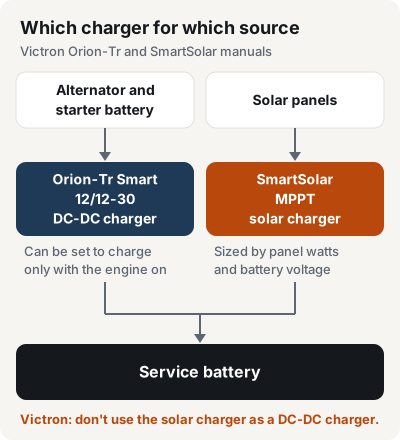
A DC-DC charger and an MPPT solar charger fill the same service battery from different sources. The Victron Energy Orion-Tr Smart 12/12-30 charges it from the starter battery while the engine runs, and a SmartSolar MPPT charges it from solar panels. Victron's MPPT manual says to avoid using the solar charger as a DC-DC charger and to use a dedicated DC-DC charger instead, so a van or RV that charges from both the alternator and roof panels needs one of each.
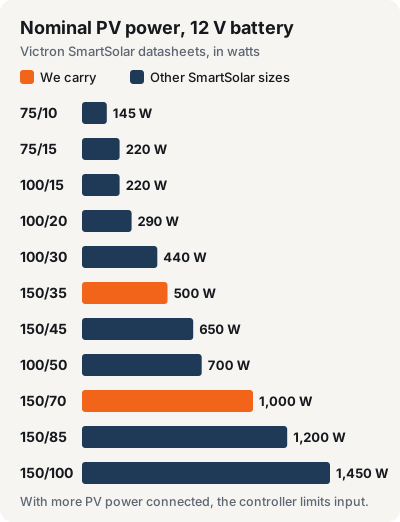
The MPPT is sized by array watts and battery voltage. Victron's datasheets give each controller a nominal PV power: on a 12 V battery, 500 W for the SmartSolar 150/35 and 1,000 W for the 150/70.
What the Orion-Tr 12/12-30 does
The Orion-Tr Smart works as a DC-DC battery charger or as a power supply with a fixed output voltage. In a vehicle it sits between the starter battery and the service battery.
- Engine shutdown detection: it can be set to provide power only while the engine runs, without a separate engine run sensor or a connection to the CAN bus. An external allowed-to-charge signal can also turn it on. The manual doesn't recommend the ignition switch for this, because it can drain the starter battery when the ignition is on and the engine is off.
- Smart alternators: the engine running detection keeps it from draining the starter battery when a smart alternator stops supplying power.
- Lithium service batteries: Victron says controlled charging protects the alternator, which direct charging can overload because of the lithium battery's low impedance.
- With the engine off, it separates the starter battery from the service battery.
The 12/12-30 is rated 30 A continuous at its nominal output voltage and 40°C, and 360 W continuous output power at 40°C. At 25°C the continuous output is 430 W. It takes 8–17 V in, puts out a nominal 12.2 V (adjustable 10–15 V) and charges in three adaptive stages: bulk, absorption and float. For lithium batteries the absorption time is fixed, 2 hours by default.


For more current, Victron allows an unlimited number of units in parallel. Ours is the non-isolated version. It's set up and monitored over Bluetooth in the VictronConnect app and has no VE.Direct port.
Tip Where the alternator voltage doesn't give the engine shutdown detection enough to work with, the manual says an external engine running signal can be used instead. The manual's fuse recommendation for 12 V is a 60 A external battery protection fuse.
What a SmartSolar MPPT does
The model name gives the two limits. A 150/35 is rated for a maximum PV open-circuit voltage of 150 V and a charge current of up to 35 A.
- To start, the PV voltage has to exceed the battery voltage by 5 V. After that it can drop to 1 V above the battery voltage.
- The 150 V models list 150 V as the absolute maximum open-circuit voltage in the coldest conditions, and 145 V as the start-up and operating maximum.
- If the array is bigger than the nominal PV power, the controller limits the input power.
Warning Panel open-circuit voltage rises in the cold. Victron's manual says to take each panel's open-circuit voltage and its temperature coefficient into account before deciding how many go in series, since below 25°C the voltage will be higher. A PV array with a higher short circuit current than the controller's rating may damage it.
Why one charger doesn't do both jobs
Victron's MPPT manual says to avoid using the solar charger as a DC-DC charger (its example is charging a 12 V battery from a 24 V bank), because connecting a battery to the PV terminals can, under certain operating conditions, damage it. The manual sends you to a dedicated DC-DC charger.
The Orion-Tr documents describe charging from a starter battery and alternator, with an input range of 8–17 V. The panels go to the MPPT.
Which MPPT size for your array
Victron rates every SmartSolar controller by nominal PV power at each battery voltage. Pick one whose rating at your battery voltage covers the array's watts.
| SmartSolar MPPT | 12 V battery | 24 V battery |
|---|---|---|
| 75/10 | 145 W | 290 W |
| 75/15 | 220 W | 440 W |
| 100/15 | 220 W | 440 W |
| 100/20 | 290 W | 580 W |
| 100/30 | 440 W | 880 W |
| 150/35 | 500 W | 1,000 W |
| 150/45 | 650 W | 1,300 W |
| 100/50 | 700 W | 1,400 W |
| 150/70 VE.Can | 1,000 W | 2,000 W |
| 150/85 VE.Can | 1,200 W | 2,400 W |
| 150/100 VE.Can | 1,450 W | 2,900 W |
The watts follow the second number. At 12 V the 100/50 is rated 700 W and the 150/35 is rated 500 W. The first number sets how much panel voltage the controller accepts, which decides how many panels can go in series.
Victron's manual gives an example for a 24 V battery on a 150 V controller: at least 72 cells in series (two 12 V panels or one 24 V panel), 144 cells for the highest controller efficiency, and no more than 216 cells. The manual also points to Victron's online MPPT sizing calculator.
SmartSolar 150/35 or 150/70-Tr VE.Can
Both take 12, 24 or 48 V batteries with automatic selection; 36 V is set manually. Both have Bluetooth and a VE.Direct port.
| Spec | 150/35 | 150/70-Tr VE.Can |
|---|---|---|
| Charge current | 35 A | 70 A |
| Nominal PV power, 12 V | 500 W | 1,000 W |
| Nominal PV power, 24 V | 1,000 W | 2,000 W |
| Max. PV short circuit current | 40 A | 50 A |
| Power terminals | 16 mm² (AWG6) | 35 mm² (2 AWG) |
| VE.Can | No | Yes |
The 150/70-Tr VE.Can adds a remote on/off connector, a programmable relay and a socket for an optional plug-in display. Up to 25 units synchronize over VE.Can, and up to 10 over Bluetooth.

Picking the chargers
- Charging from the engine: the Orion-Tr Smart 12/12-30, rated 30 A continuous at 40°C into a 12 V service battery.
- Arrays up to 500 W nominal PV power on a 12 V battery: the SmartSolar MPPT 150/35.
- Arrays up to 1,000 W nominal PV power on a 12 V battery, or several controllers on VE.Can: the SmartSolar MPPT 150/70-Tr VE.Can.
Our other solar and networking products are in Networking & Solar Power.
FAQ
Do I need a DC to DC charger for solar?
No. Solar panels connect to the MPPT solar charger. A DC-DC charger such as the Orion-Tr charges the service battery from the starter battery and alternator, and Victron's MPPT manual says to avoid using the solar charger as a DC-DC charger.
Why do I need a DC to DC charger?
Victron's Orion-Tr manual says controlled charging is indispensable with a smart alternator, and that in lithium systems it protects the alternator, which direct charging can overload. The Orion-Tr also separates the starter and service batteries when the engine is off.
What size MPPT do I need for a 400-watt solar panel?
On a 12 V battery, Victron rates the SmartSolar 100/30 at 440 W and the 150/35 at 500 W nominal PV power. On a 24 V battery, the 75/15 and 100/15 are rated 440 W, and the panel voltage must also exceed the battery voltage by 5 V for the controller to start. The array's open-circuit voltage in the coldest conditions must also stay under the controller's maximum PV voltage.
What size Victron MPPT do I need?
Find your battery voltage in the table above and pick the first controller whose nominal PV power covers the array's watts. Then check the array's open-circuit voltage in the coldest conditions against the first number in the model name (on the 150 V models, 145 V is the start-up and operating maximum), and its short circuit current against the datasheet. If the array is bigger than the nominal rating, the controller limits the input power.
Specifications come from Victron Energy's documents: the Orion-Tr Smart non-isolated datasheet and manual, the SmartSolar 150/35 & 150/45 datasheet and MPPT solar charger manual, the SmartSolar VE.Can 150/70 to 150/100 datasheet, and the SmartSolar 75/10 to 100/20 and 100/30 & 100/50 datasheets.