
Honeywell 7800 SERIES Flame Amplifiers: Matching R7847, R7848, R7849 and R7886
How to pick a Honeywell 7800 SERIES plug-in flame amplifier: detector type, AMPLI-CHECK or self-check, flame failure response time and the flame signal to expect.

In this guide
A flame amplifier is the plug-in card in a Honeywell 7800 SERIES relay module that works with the flame detector on the burner. Honeywell's RM7890 product data says the subbase and an amplifier are required to complete the system.
Picking a replacement comes down to three things: the detector it has to work with, whether and how the amplifier checks itself, and its flame failure response time (FFRT).
This guide uses the amplifier table in the RM7890 product data (form 65-0126). Other 7800 SERIES relay modules and amplifiers have their own Honeywell documents.
Match the amplifier to the detector
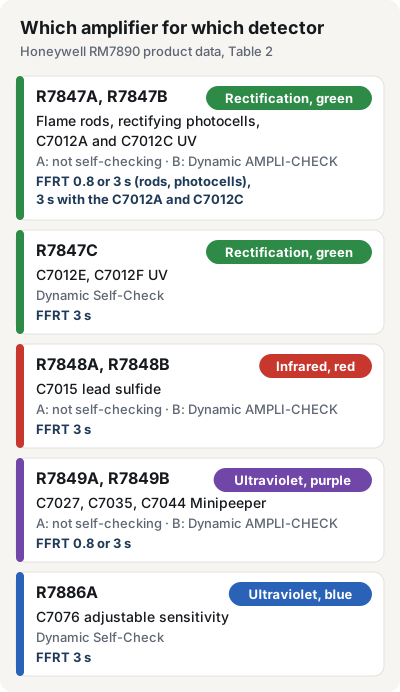
Honeywell gives each amplifier family its own color, and its Table 2 lists the detectors each one works with.
| Amplifier | Type, color | Detectors |
|---|---|---|
| R7847A, R7847B | Rectification, green | Flame rods, photocells, C7012A and C7012C UV |
| R7847C | Rectification, green | C7012E, C7012F UV |
| R7848A, R7848B | Infrared, red | C7015 lead sulfide |
| R7849A, R7849B | Ultraviolet, purple | C7027, C7035, C7044 Minipeeper |
| R7886A | Ultraviolet, blue | C7076 adjustable sensitivity |
For flame rods, Honeywell lists the C7004, C7007 and C7011 holders (flame rod ordered separately) and the C7008, C7009 and Q179 complete assemblies. The rectifying photocells are the C7003, C7010, C7013 and C7014. With the R7847B, Honeywell says to use only Honeywell photocell part no. 38316. The C7012 is Honeywell's Purple Peeper UV detector.
Standard, AMPLI-CHECK or self-check
- The R7847A, R7848A and R7849A are not self-checking, per Table 2 of Honeywell's RM7890 product data. A footnote to the flame signal table in the same document groups the A and B models as AMPLI-CHECK type; This guide follows Table 2, Honeywell's amplifier selection table.
- The R7847B, R7848B and R7849B have Dynamic AMPLI-CHECK. It tests the amplifier at least 12 times a minute while the burner runs and shuts the burner down if the amplifier fails.
- The R7847C and R7886A have Dynamic Self-Check. It tests the amplifier and the detector 12 times a minute while the burner runs and shuts the burner down if the detection system fails.
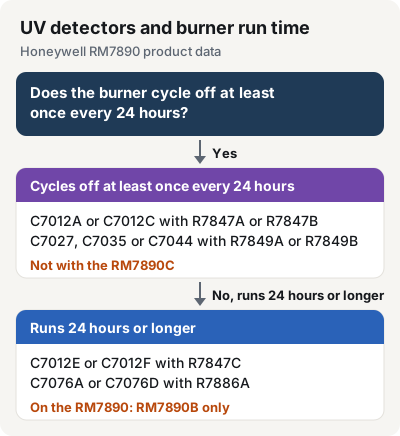
For UV detection, the burner's run time decides the choice. Honeywell says the C7012A, C7012C, C7027, C7035 and C7044 detectors should be used only on burners that cycle off at least once every 24 hours. Burners that stay on for 24 hours or longer should use a C7012E or C7012F detector with an R7847C, or a C7076A or C7076D detector with an R7886A.
On the RM7890, Honeywell lists the R7847C and R7886A for the RM7890B only. The product data also warns not to use the non-self-checking UV detectors (C7027, C7035, C7044, C7012A and C7012C) with the RM7890C, whichever amplifier they run with.
Flame failure response time
Honeywell's Table 2 lists a flame failure response time (FFRT) for each amplifier:
- R7847A and R7847B: 0.8 or 3 s with flame rods and rectifying photocells, 3 s with the C7012A and C7012C.
- R7849A and R7849B: 0.8 or 3 s.
- R7847C, R7848A, R7848B and R7886A: 3 s.
Warning On the RM7890, a 0.8 s amplifier is required when the relight option is selected. With a 3 s amplifier and the JR2 lockout jumper left in place, the RM7890 locks out and shows Fault 46.
Tip The label on our R7847A1033 reads "2 or 3 sec, see relay module", which differs from Table 2 in the 1994 RM7890 product data, so check the FFRT in the relay module's documents.

Checking the flame signal
Honeywell's checkout calls for a steady flame signal of at least 1.25 V DC with every amplifier in the table. The maximum expected reading is 5.0 V DC, measured at the Keyboard Display Module or with a voltmeter of at least 20 kohm/volt sensitivity. The minimum has to be reached before checkout is complete. With AMPLI-CHECK or shutter-check amplifiers the reading moves; Honeywell says to read the average stable voltage at the amplifier's + and − (Com) test jacks.
The S7800A1001 Keyboard Display Module shows the flame signal, the amplifier type and the FFRT, along with the six most recent faults.

Honeywell also has you run the burner until the combustion chamber reaches its maximum expected temperature, then recycle it, measure the flame signal (the pilot alone on non-DSI burners, the main flame on direct spark ignition) and time the FFRT (0.8 or 3 s maximum, depending on the amplifier). If the signal is too low or unsteady, check the detector temperature, move the detector if it runs too hot and, if necessary, realign its sighting. If the response time is still too slow, replace the plug-in amplifier. After moving or resighting the detector, or replacing the amplifier, repeat all required checkout tests.
Replacing a plug-in amplifier
Honeywell says the installer must be a trained, experienced flame safeguard service technician. The RM7890 product data gives these steps:
- Disconnect the power supply. More than one disconnect may be involved.
- Line up the amplifier's circuit board edge connector with the keyed receptacle on the relay module, with the amplifier nameplate facing away from the relay module.
- Push the amplifier in until the board is fully seated, then push it toward the retaining clasp.
- Check that the amplifier is firmly in place, then run all required checkout tests.
Honeywell parts we carry
- Honeywell R7847A1033, rectification flame amplifier, not self-checking.
- Honeywell S7800A1001, Keyboard Display Module for 7800 SERIES burner controls.
For a complete ordering number, Honeywell's product data refers to its TRADELINE catalog. Other burner and HVAC controls are in HVAC, Plumbing & Water Heating.
FAQ
What does a flame amplifier do?
It works with the flame detector to supervise the burner flame for the relay module. Together they form the flame detection system, and the amplifier has to be one Honeywell lists for that detector. The R7847A and R7847B, for example, are rectification amplifiers that Honeywell also lists for the C7012A and C7012C UV detectors, on burners that cycle off at least once every 24 hours and not with the RM7890C. On the RM7890, the R7847C (for the C7012E and C7012F) is listed for the RM7890B only.
Which detectors work with the R7847A1033?
Honeywell lists the R7847A for flame rods (C7004, C7007, C7011 holders, flame rod ordered separately; C7008, C7009, Q179 assemblies), rectifying photocells (C7003, C7010, C7013, C7014) and the C7012A and C7012C Purple Peeper UV detectors, which Honeywell limits to burners that cycle off at least once every 24 hours. Honeywell says not to use the C7012A or C7012C with the RM7890C. The label on the R7847A1033 reads "use with flame rod".
Specifications come from Honeywell's RM7890 product data (form 65-0126) and the S7800A1001 Keyboard Display Module product data (form 65-0090).